Session 79 — March 2026
Europe: rearmament, unity and the risk of reverting to old conflicts ▶ Play excerpt07:40
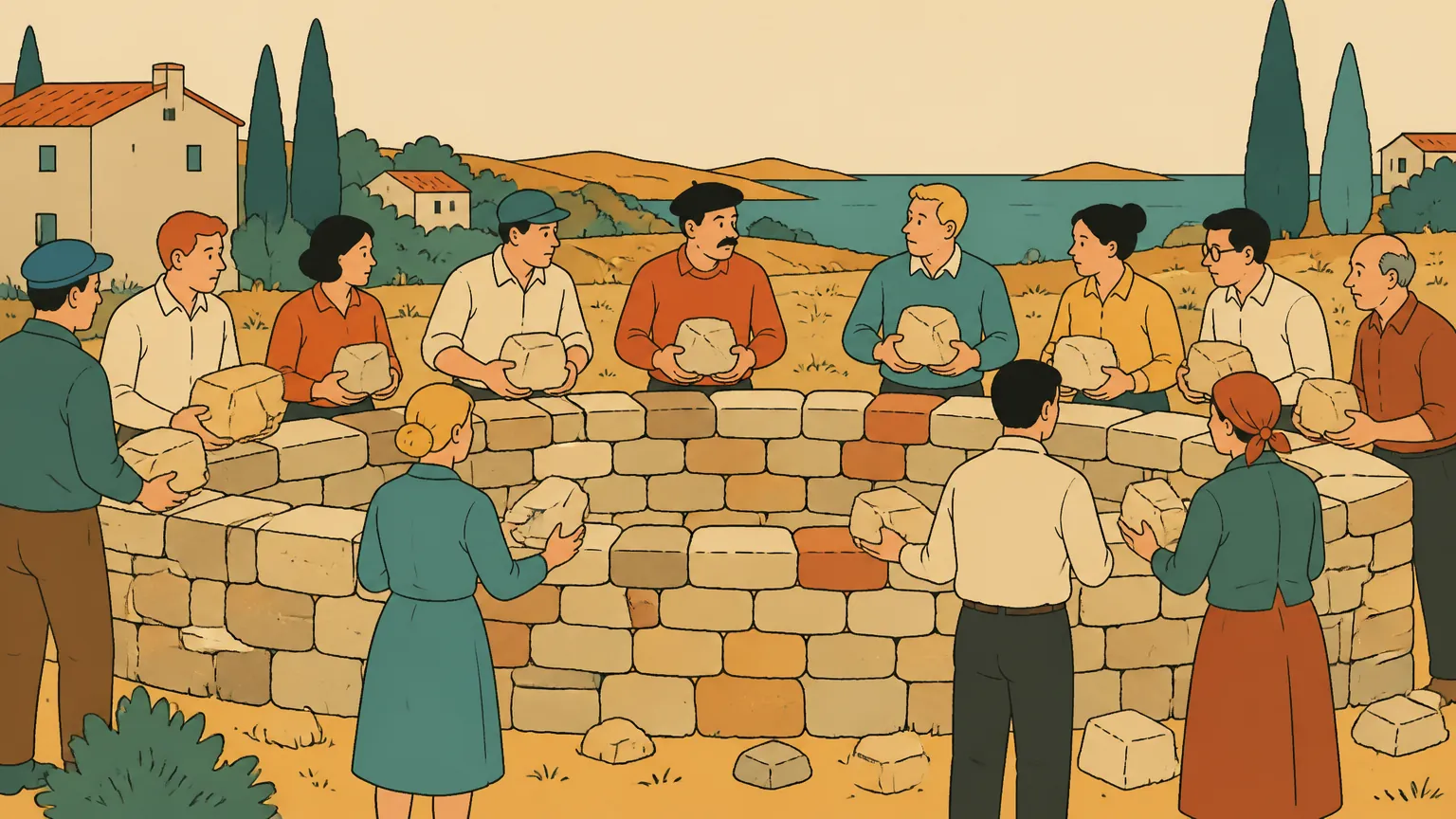
Frederic says Europe is a mystery to him: historically every country has fought every other, and he questions whether rearming is a good idea.
The Wonders say there is always a potential for conflict, and that Europe is arming to protect itself from Russian and American aggression and to some degree Chinese, though China is currently focused on Taiwan and the east.
They observe that the same constructs and mentality that existed 200,000 years ago persist - everybody loves to hate everybody and nobody truly accepts anybody, though they pretend well - while the European Union has nonetheless produced better mutual understanding.
They warn that Donald Trump, while not currently focused on Europe, will eventually try to pit one country against another, and it will be for European countries to choose whether to revert to old conflicts or move forward peacefully using diplomacy, communication, understanding and mutual appreciation as a means of enhancing their own safety.
Arming Europe is not counterproductive, but the key is not to let Europe fall into having a single leader.
Where Russia, China and the United States are each ruled to some degree by a dictator - and singular individuals can create far more havoc - an amalgamation of countries that accept and appreciate each other will have more success, and Europe could become one of the great powers and a powerful voice for freedom, provided it stays peaceful and sees itself as a oneness of different countries and cultures with none better than another.
In a lighter exchange they note that the Spanish, French, Germans, Belgians, Italians, South Slavs and British have all tried to assert themselves and all have been beaten down; Luxembourg and to a degree Switzerland are exceptions, and Canada is named as never having tried to conquer Europe, making it an ally worth fostering.
Without mutual respect, one individual will always rise to overcome the others - they cite the far right around Marine Le Pen in France, and similar movements in Italy and to a lesser extent Spain.
Their recommendation is that the European Union work more diligently at influencing, not controlling, the narrative toward cooperation.
Living in the moment, the fear of fear, and the fear of death ▶ Play excerpt07:16
Frederic says he has few prepared questions and now approaches things moment by moment with no plan, which the Wonders endorse.
They then ask what one thing he is most afraid of that would take him out of the moment; he answers 'fear'.
They press: is fear real?
Can it be touched, smelled, tasted, seen or heard?
The body reacts to it and the reactions are visible, but fear itself cannot be perceived by the five senses - so why give in to it, and why be afraid of it?
They then list the many ways a body can die - being shot, hit by a truck, beaten, stabbed - and ask why he fears death when he has never experienced it in this form.
Death can be observed from outside: one sees a person dying, hears the death rattle, feels the body grow cold as circulation stops, and the body is dead.
But what happens to the 'you' - the personality, the ego, the self-identity?
Is it killed, or does it go through what they call integration and reevaluation with the soul essence?
Since the end is integration and reevaluation with one's soul essence, why fear death?
Frederic replies that he does not know whether he is afraid of death.
The Wonders say perhaps he is not, and perhaps he understands the process - but if so, he can see the fear in others, and others reflect something back to him; perhaps a fear of death was once inside him and he now understands it differently, or perhaps not.
They suggest he explore it.
Understanding things from a broader perspective makes it easier to choose the interactions one wants in order to expand; without understanding, one simply waits and reacts to whatever happens and sees oneself as a victim, perpetually victimized by events.
They tie this back to Europe: is Europe a victim, is it victimizing itself, or is his own fear in exploring it creating a sense of victimization between himself and Europe?
Frederic says it is a mystery which way it will go; the Wonders reply that his mind wants to know because his mind loves control and wants to be told what will happen so it can decide whether to participate.
When he reframes it as interesting to see which way it goes, they ask why, if he wants to be an observer, he needs to define it as interesting at all.